A new investment in decentralised seed systems, youth enterprise, and stronger rural livelihoods in Nakuru County
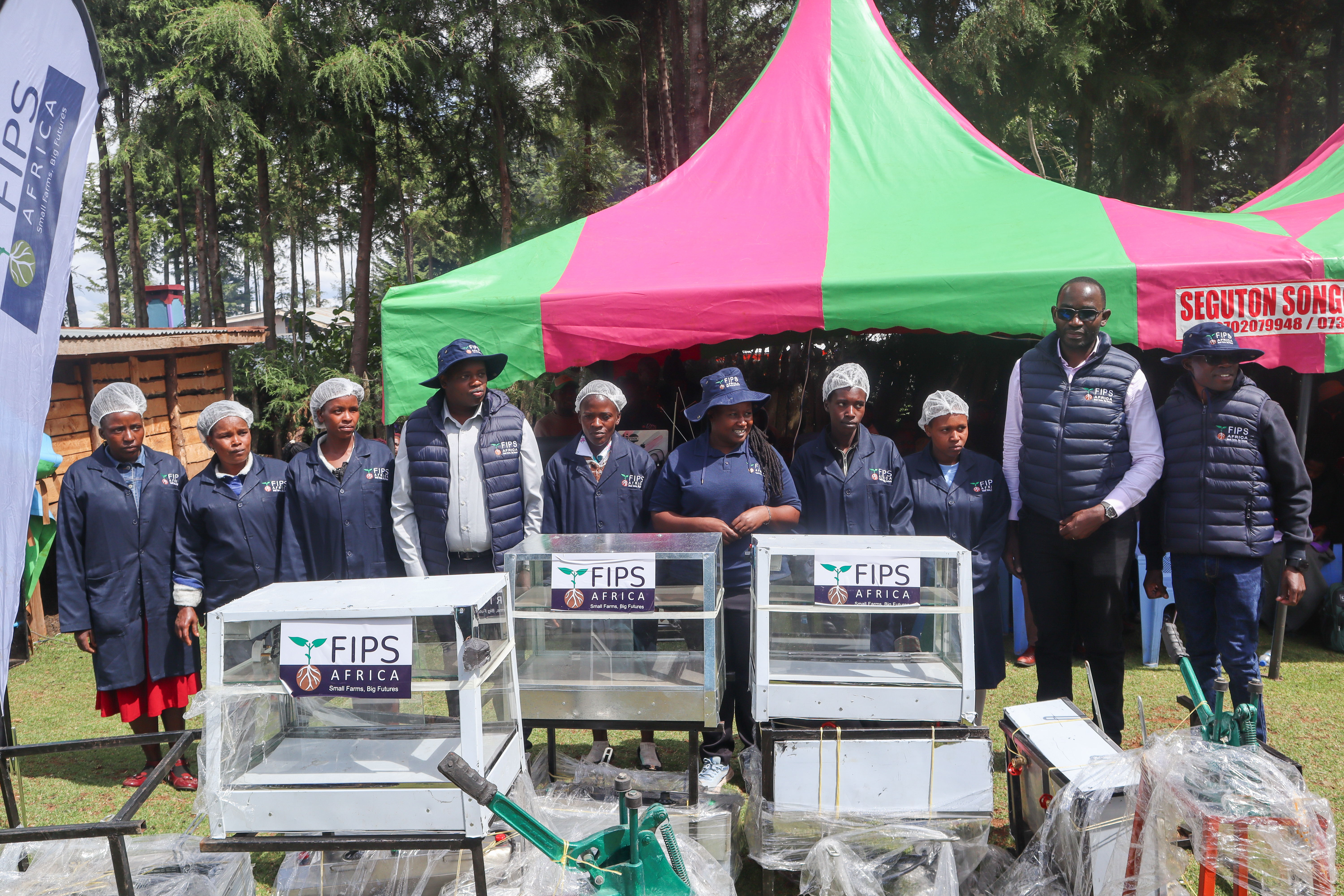
FIPS Africa, in partnership with the Nakuru County Government, has launched 100 Diffused Light Stores (DLSs) and agribusiness equipment for youth in Mwahe Village, Nakuru County – a practical step towards strengthening the potato value chain, reducing post-harvest losses, and creating more viable agribusiness opportunities for young people.
The launch reflects a shared commitment to building more inclusive and resilient local food systems by improving access to quality seed potato, supporting village-level seed businesses and expanding income opportunities for youth. It also speaks directly to FIPS Africa’s wider Small Farms, Big Futures strategy, which combines practical farmer support, youth enterprise, and market systems development to help smallholder families build stronger livelihoods.
Addressing a key bottleneck in the potato value chain
Access to quality seed potato remains one of the biggest challenges facing potato farmers. Poor storage, high post-harvest losses, and premature sprouting reduce seed quality and limit timely access to seed for planting. Within the current seed system, both farmers and Village-based Advisors face challenges in maintaining quality and ensuring a reliable supply.
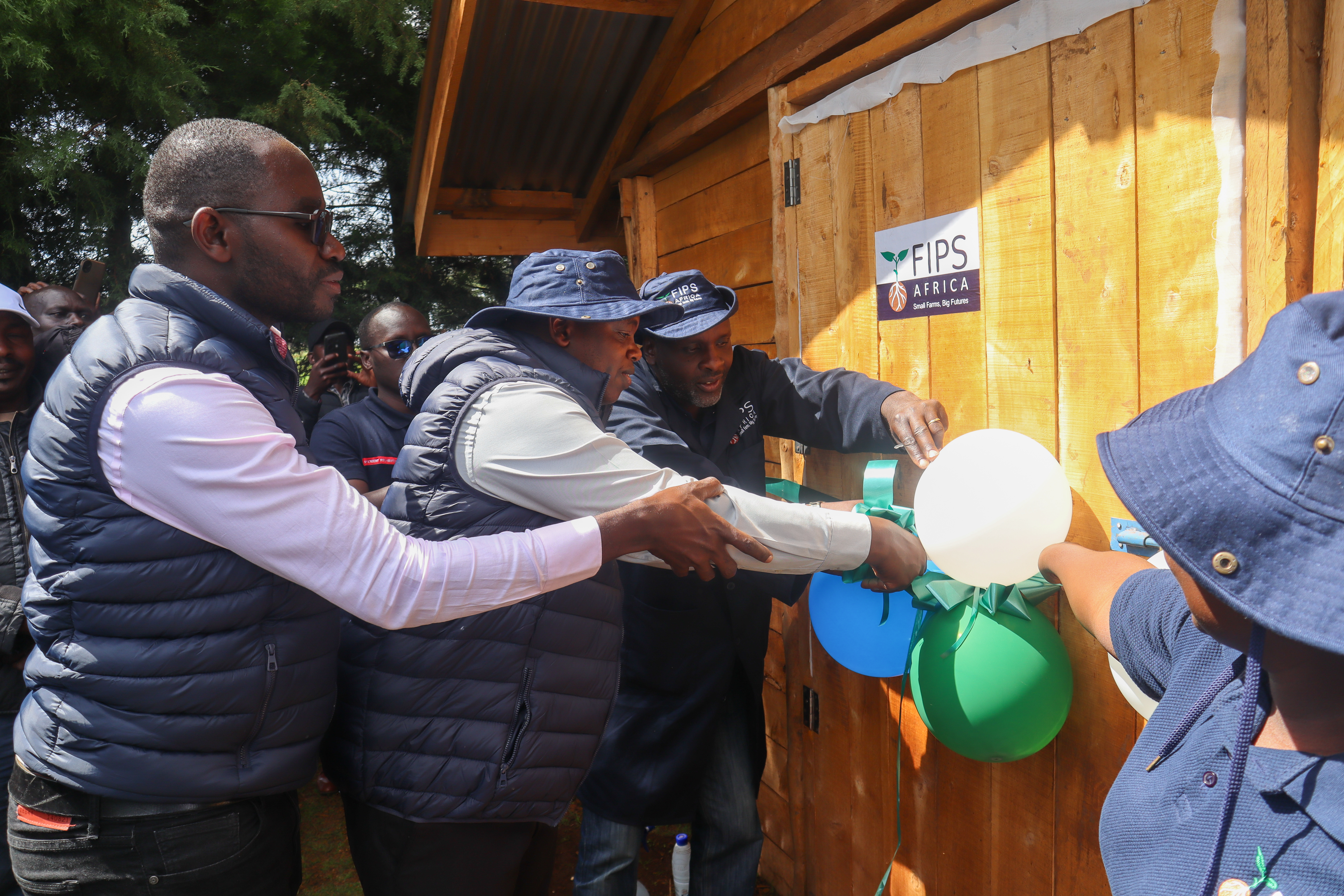
The newly launched Diffused Light Stores are designed to address this problem directly.
Each store has a 5-tonne capacity, and together the 100 stores represent a KES 17 million investment in better storage, reduced losses, and improved seed quality. The model is also transitioning towards cost-sharing to strengthen sustainability and local ownership over time.
For farmers, this matters because better storage means better seed. And better seed means stronger yields, more reliable planting, and improved incomes.
Why the DSM approach matters
At the heart of this work is the Decentralised Seed Multiplier (DSM) approach.
DSMs are farmers or farmer groups who are registered and known as seed producers within their villages. Because their focus is on producing quality seed and they are based close to farmers, they form a reliable local market base for seed potato. The Diffused Light Store initiative specifically supports them by allowing proper storage and helping them reduce post-harvest losses. In Nakuru, the 100 DLSs mean that DSMs can now store seed potatoes more effectively and serve nearby farmers with greater consistency.
This is important not only for seed quality, but also for access. When quality seed is stored closer to farming communities, farmers can get it faster and more easily, within a shorter distance from home. The expected value includes:
- Improved availability of quality seed
- Reduced seed losses in storage and handling
- Increased farmer incomes
- Stronger decentralised seed systems
- Faster and closer seed access for farmers
A partnership model for sustainable scale
The launch in Nakuru is not only about infrastructure. It is also about building a partnership model that can scale.
The DLS initiative is based on co-investment with county governments, integration into extension systems, capacity building for Village-Based Advisors (VBAs) and seed multipliers, and stronger market linkages. The approach is also intended to support access to finance for further expansion, including the future construction of 500 Diffused Light Stores.
This model reflects how FIPS Africa sees long-term change happening: not through isolated projects, but through practical, locally rooted systems that involve governments, market actors, extension networks, and rural entrepreneurs working together. FIPS’ strategy explicitly emphasises stronger partnerships with governments, donors, research institutions, and commercial actors as essential to scaling impact and delivering systemic change.
Supporting stronger seed production through greenhouse capacity
The work on DLSs is part of a broader effort to strengthen seed production and stimulate variety adoption.
FIPS Africa has established 2 greenhouses with the capacity to produce up to 2 million Potato Rooted Apical Cuttings (PRACs) annually, enabling continuous year-round production and stronger support to decentralised seed multipliers. This greenhouse production model is intended to increase production, stimulate variety adoption, and increase incomes, while strengthening the link between research, seed production, and farmers.
The expected impact includes:
- Faster availability of quality seed potato
- Reduced disease transmission in seed systems
- Improved seed multiplication efficiency
- Accelerated variety adoption
- Increased farmer productivity and incomes
- Stronger linkage between research, production, and farmers
Youth agribusiness at the centre
Alongside the launch of the Diffused Light Stores, FIPS Africa also launched agribusiness equipment for youth.
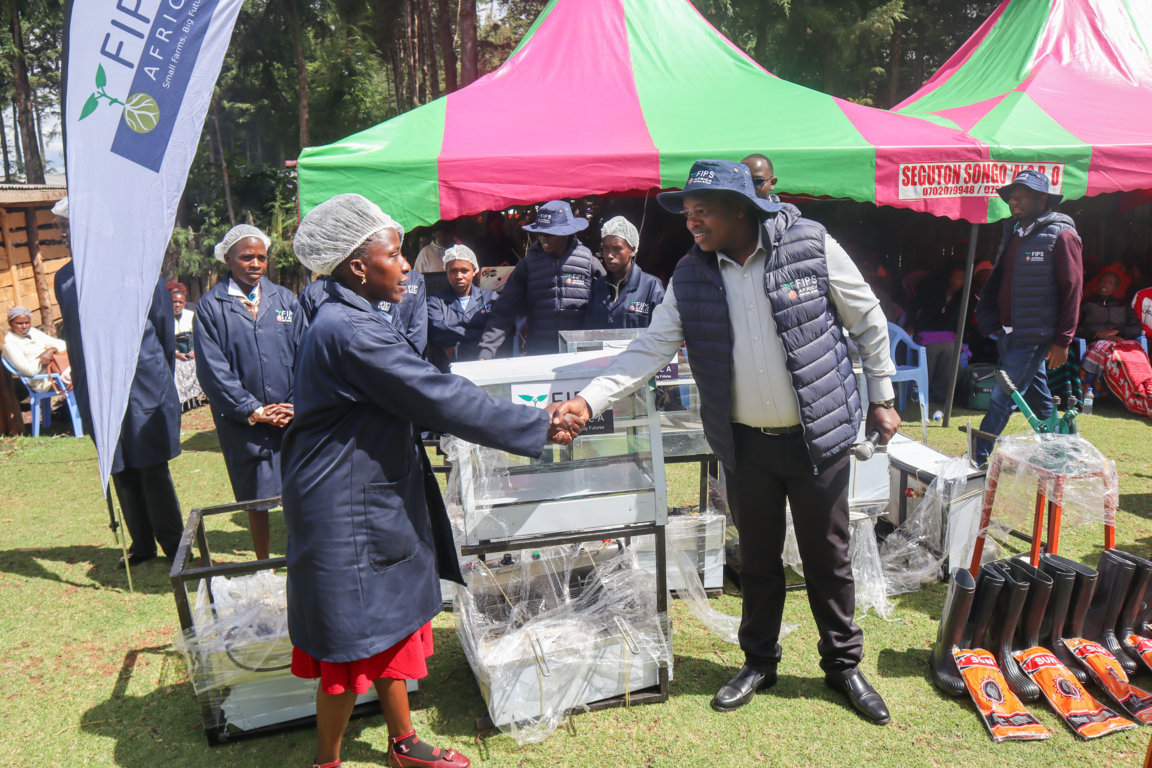
This is a significant part of the work in Nakuru County, where FIPS Africa is supporting young people to move from subsistence activities into commercially viable agribusinesses. The model combines hands-on training, trial packs, cost-sharing for pilots, enterprise development, mentorship, and linkages to markets and finance.
In Nakuru, this work has already contributed to:
- 31,819 youth trained in agribusiness
- 23,932 youth actively practising agribusiness
- 17 youth groups formally registered
Within the potato value chain specifically:
- 7 groups are working as Decentralised Seed Multipliers
- They are producing an average of 30 tonnes of seed per season
- and supporting cultivation across 33 acres
Beyond seed production:
- 13 youth group representatives have been supported to establish potato value addition enterprises
- These enterprises are targeting the purchase of 13 tonnes of ware potato per month
- creating 52 direct employment opportunities
- and generating an estimated KES 48.3 million in annual income
In addition:
- 40 individuals are providing crop spray services
- expected to cover 1,750 acres per month
- offering 160 direct youth employment opportunities
- and generating approximately KES 8.4 million in annual income
These figures show that youth agribusiness is not an add-on. It is already a major part of how local food systems, service markets, and rural employment are being strengthened in Nakuru.
The role of Village-based Advisors
A key strength of FIPS Africa’s model is the role played by Village-Based Advisors.
VBAs are community-based extension actors who connect farmers to information, inputs, and opportunities at the last mile. FIPS’s wider strategy notes that the VBA model has transformed extension by making it more accessible, cost-effective, and locally tailored, while also creating pathways for VBAs to move along a continuum from community service to community enterprise.
In the context of Nakuru’s potato work, VBAs are doing more than extension. They are increasingly part of the local seed and enterprise system — supporting seed multiplication, helping farmers access quality inputs, and contributing to stronger local markets.
This is central to the Small Farms, Big Futures approach, which focuses on practical technologies, farmer confidence, local market access, and support systems that make it easier for smallholders and young people to build sustainable livelihoods.