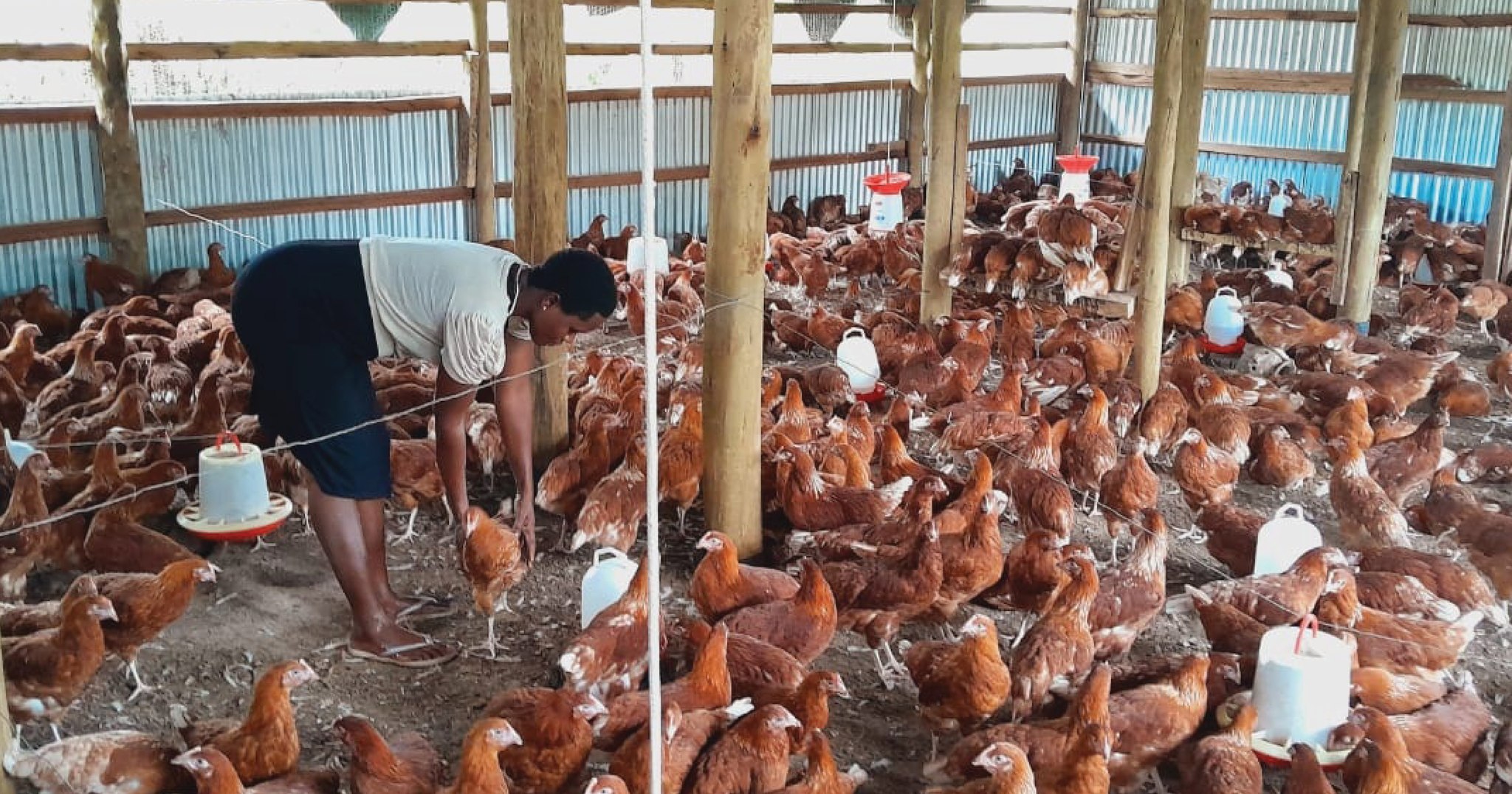
As we arrive in Stacy’s poultry yard in Bukhayo, Busia County, she is already deep into her morning routine. Nearly 2,000 laying hens cluster around her as she pours feed into long troughs, a carefully balanced blend of homemade formulation and commercial rations.
She turns and says with certainty: “The secret in chicken farming is minimising costs. Make your feeds. That is where the profit begins.”
Today, Stacy runs a profitable poultry enterprise. But less than two years ago, she was struggling to make livestock production viable.
From underemployment to structured enterprise development
Stacy, 30, joined the FIPS Africa Youth Enterprise Programme in November 2023. Despite holding a diploma in social work, her attempt at pig rearing was constrained by limited technical skills, weak market linkages, and inadequate production systems. Like many rural youth, she faced the classic barriers to enterprise growth: fragmented training, poor access to quality inputs, and limited business acumen.
FIPS Africa’s approach addresses these systemic gaps.
Through structured training in poultry production and African leafy vegetable management, Stacy gained practical, market-oriented technical skills. Through the 50–50 cost-share model, she accessed quality starter inputs while maintaining financial commitment and ownership – strengthening accountability and commercial discipline from the outset.
Critically, support did not end with training. Ongoing technical backstopping, business mentoring, and market linkage support ensured her transition from trainee to entrepreneur.
Building a commercially viable scale
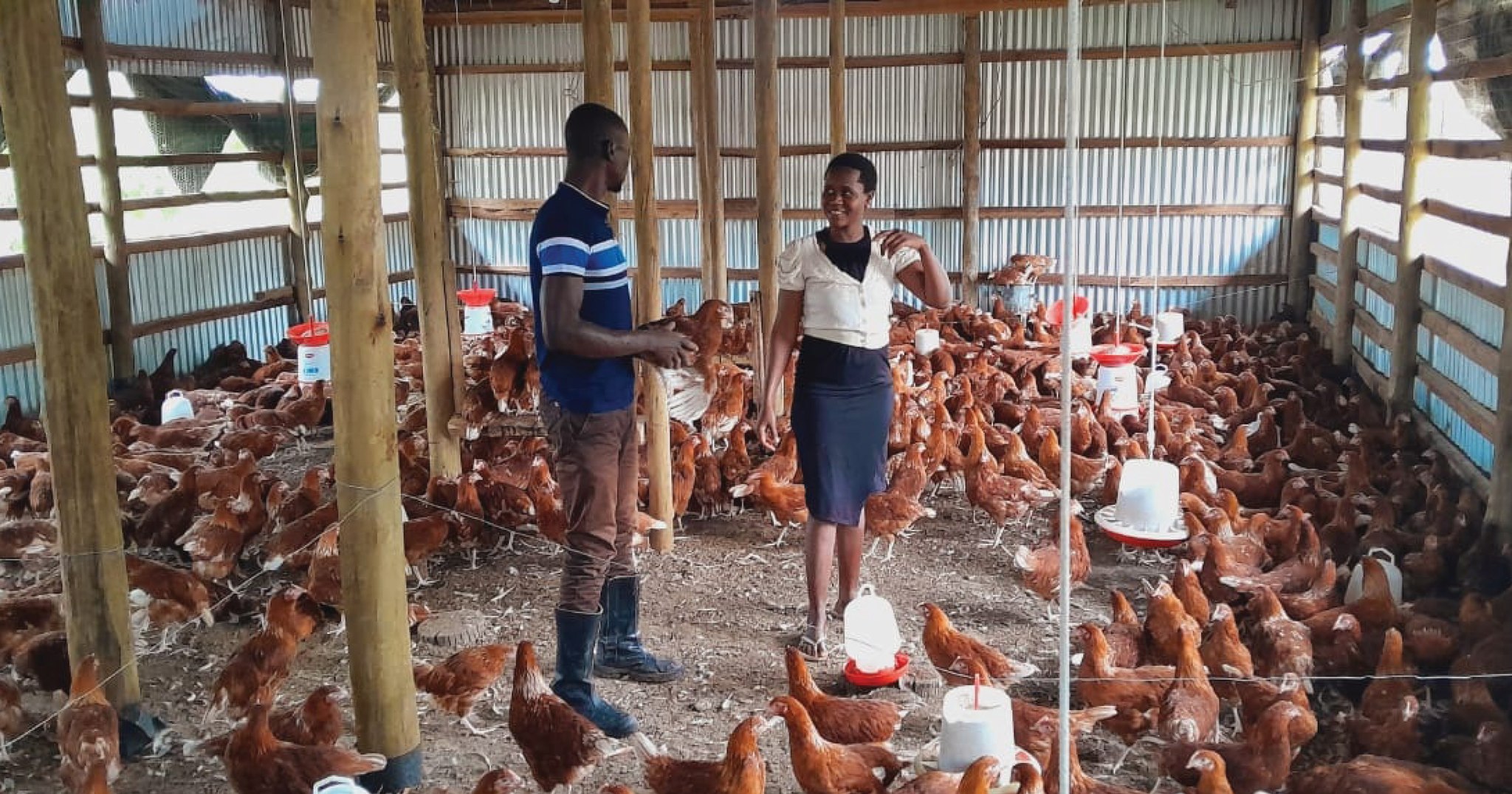
Today, Stacy manages over 1,900 laying hens, a scale that reflects structured growth rather than subsistence activity. Her enterprise generates sufficient and consistent cash flow to meet household expenses, pay her children’s school fees, reinvest in business expansion, and improve production efficiency.
By formulating part of her poultry feed locally, she reduces input costs and protects margins, a key determinant of enterprise sustainability. Through business skills training, she now leverages social media marketing to expand beyond local markets, increasing demand reliability and strengthening price negotiation power.
Stacy is no longer experimenting with agribusiness. She is running a commercially oriented rural enterprise.
Scaling youth-led agribusiness ecosystems
Stacy’s story reflects a broader systems-level intervention.
She is one of over 200,000 young people supported by FIPS Africa through targeted training, structured input access, and ongoing advisory support. Of those reached, more than 50,000 youth have established multiple thriving business enterprises, diversifying income streams and reducing vulnerability to market and climate shocks.
This is not a one-off success. It is a replicable model.
FIPS Africa’s youth enterprise programming integrates practical, market-aligned technical training, cost-shared access to quality inputs, last-mile advisory support through decentralised networks, business skills development, market access facilitation, and continuous performance monitoring.
By embedding youth into functioning agricultural value chains rather than treating them as isolated beneficiaries, the model builds commercially viable micro-enterprises that can scale organically.
A pathway to resilient rural economies
Stacy’s confidence is visible as she moves through her poultry unit, checking feed lines, inspecting birds, and reviewing orders. She speaks not as a trainee, but as a business owner.
Her advice remains simple:
“With a goal, commitment, and persistence, anyone can start building a business and earn a decent income.”
But behind that confidence lies a structured support ecosystem designed to reduce risk, strengthen capability, and enable growth.
Stacy represents the power and potential of Kenya’s youth when systemic barriers are addressed through practical, scalable solutions. Through its youth enterprise programming, FIPS Africa is not only creating individual success stories — it is strengthening rural enterprise systems, expanding employment pathways, and building more resilient local economies.
And this is only the beginning.