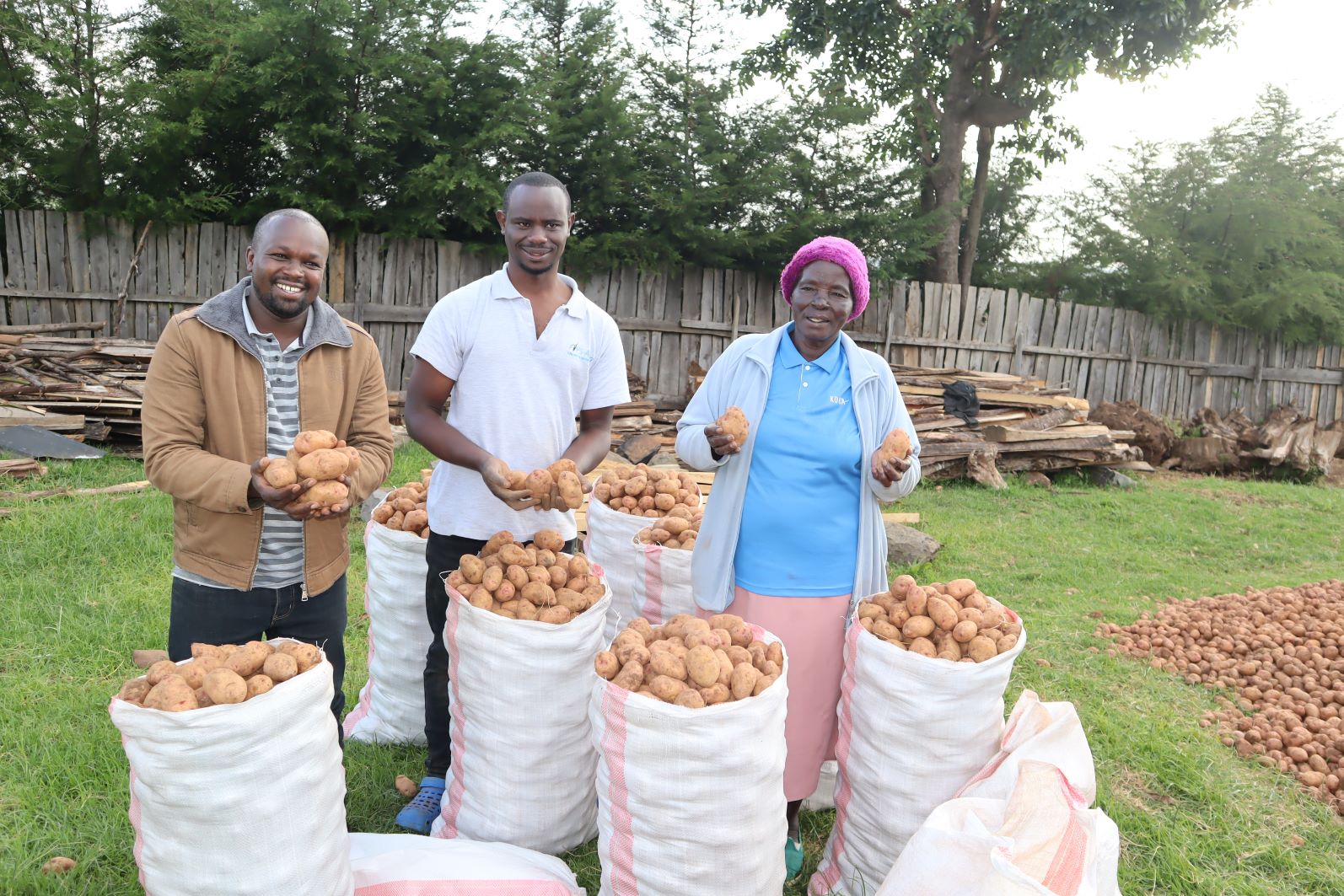
The sun dips low over Kaplelach village, Nakuru County, painting the sky in hues of orange and gold. Calves frolic in the compound while cows graze lazily, their soft lowing mingling with the laughter of children playing nearby. Amid this pastoral scene, Mary Bore and her five handsmen move steadily among humongous piles of freshly harvested potatoes. Their hands, calloused from hours of labour, work tirelessly, sorting and stacking as evening settles in. Despite the fatigue, there is an unmistakable pride in the air; the fruits of months of careful nurturing lie heaped around them.
Mary’s journey began in August 2022, at a farmers’ field day in her village. A FIPS Africa team introduced her to potato-rooted apical cuttings (PRACs) – tiny seedlings that looked more like tomato plants than potatoes. Intrigued, she purchased a tray with 200 cuttings, eager to see if these small plants could transform her farm.
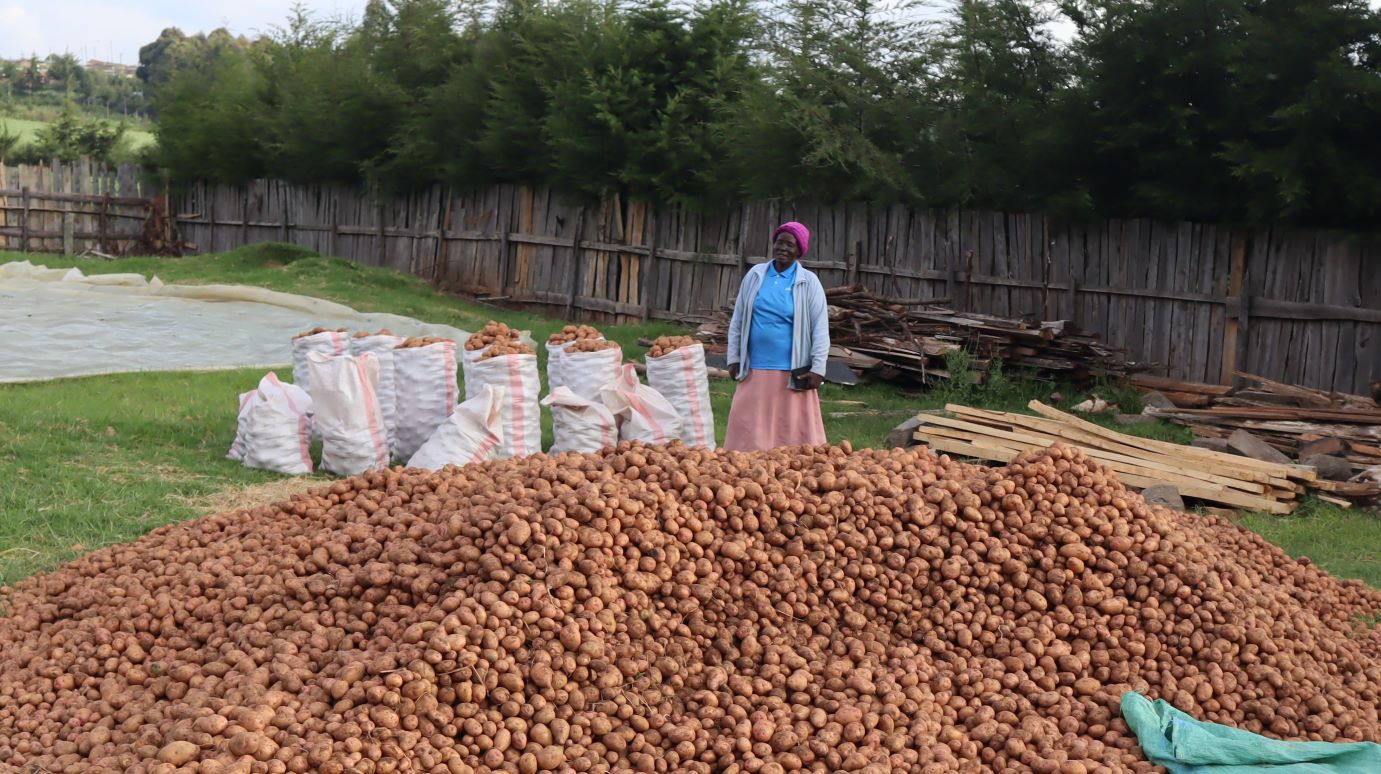
Over the next four seasons, Mary multiplied the seedlings into a thriving crop. Recently alone, she harvested 235 bags of 50 kilograms each – 11.75 tonnes of potatoes – more than double her previous yield of 100 bags from recycled seed.
“This was a record harvest on my farm. I was used to harvesting 100 bags from recycled potato seed,” says Mary, who is now among over 70,000 farmers in Nakuru benefiting from PRACs, which are helping farmers turn potato cultivation into a profitable enterprise.
A revolutionary seed system in Nakuru
FIPS Africa’s work in Nakuru County has transformed local potato production. Through a 20,000-cuttings-capacity greenhouse, FIPS produces high-quality, disease-free PRACs. Farmers can access a tray of 200 cuttings for just KSh 2,000 (KSh 10 per cutting), which can be planted to yield hundreds of kilograms of pre-basic tubers. These tubers are then multiplied further to produce ware potatoes or seed for other farmers, creating a sustainable cycle of growth and income.
Supporting this system are 169 Village-based Advisors (VBAs) and a network of Decentralised Seed Multipliers (DSMs) who help multiply and distribute seeds across the county. This network ensures last-mile access, affordable pricing, and technical guidance for farmers.
James Nyambura, coordinator of FIPS Africa’s potato seed system programme, calls the tiny tray of PRACs a game-changer for potato farming in Kenya.
“Farmers can get PRACs straight from the greenhouse,” he says. “At just KSh 10 per cutting—or KSh 2,000 for a full tray of 200—this small investment can transform a farm. With proper care, a single tray can produce hundreds of kilograms of pre-basic tubers, which can then be multiplied across an acre or more, boosting yields and incomes like never before.”
The impact: Beyond the harvest
For Mary Bore, the results speak for themselves. Her farm now produces more than double her previous yield, her income has increased, and she has confidence in the quality of her seeds. But the impact of PRACs extends beyond individual farmers. With over 70,000 farmers accessing quality seeds through FIPS Africa, Nakuru County is becoming a hub of potato production innovation, proving that smallholder farmers, with the right resources, can achieve remarkable results.
As the sun sets and the last of the tubers are stacked, Mary pauses to watch the calves scamper across her farm. The tired labourers sit for a moment, catching their breath, proud of the harvest they have brought in together. From tiny seedlings in a tray to mountains of golden potatoes, Mary’s story is a testament to innovation, perseverance, and the power of community-driven agricultural solutions.